
Pittsburg County Three-Day Release View
The official PCSO Release Report is one rolling page. There is no separate 72-hour URL or window selector. Build the three-day view from the exact released date and time on each card. That method catches late-Friday through Monday events without treating every card now visible as part of the target period.
During the research check, the page showed 33 cards over an observed span from July 24 through July 31, 2026. PCSO did not label that span as a retention term. Nor did it promise a refresh schedule. The last-updated context helps set a cutoff, but a later update may add an event whose processing was still underway.
Check Pittsburg County 72-Hour Releases
Write down the time of the review before reading cards. The report uses exact timestamps in local Central Time context. A check run at noon Monday reaches back to noon Friday, not to the start of Friday. Keeping the cutoff visible prevents an extra half-day or full day from slipping into the result.
- Open the official report and note its visible last-updated reference.
- Subtract 72 hours from the review time and label the cutoff Central Time.
- Keep cards whose released timestamp is on or after that cutoff.
- Record the booking number, arresting agency, released time, reason, and bail.
- Separate community outcomes from cards marked as release to another agency.
- Check the live jail roster for a later booking when names recur.
A person focused only on today's events can use the Pittsburg County released last 24 hours check. The three-day method is better for catch-up work because it crosses calendar-day and weekend boundaries.
Pittsburg County 72-Hour Release Fields
Every kept card should carry all of its displayed fields. The reason is vital because a release from PCSO may be a transfer. The booking number is equally useful when the same name appears in more than one custody episode.
| Field | How to read it |
|---|---|
| Name | The person name attached to the county booking. |
| Booking number | The event identifier used to distinguish separate stays. |
| Arresting agency | The agency tied to the booking, not necessarily a separate jail. |
| Released | The exact PCSO exit timestamp used for the 72-hour cutoff. |
| Reason | The local outcome label, including bond, time served, hold release, or transfer. |
| Bail | The amount shown by the source when present. |
Release cards omit photographs, charges, and court case numbers. The current PCSO Jail Roster may show those items for a person still held, while OSCN or ODCR may show the case history. Preserve the release card's booking number before the rolling page changes.
The sheriff's three-day source appears in the research capture below.
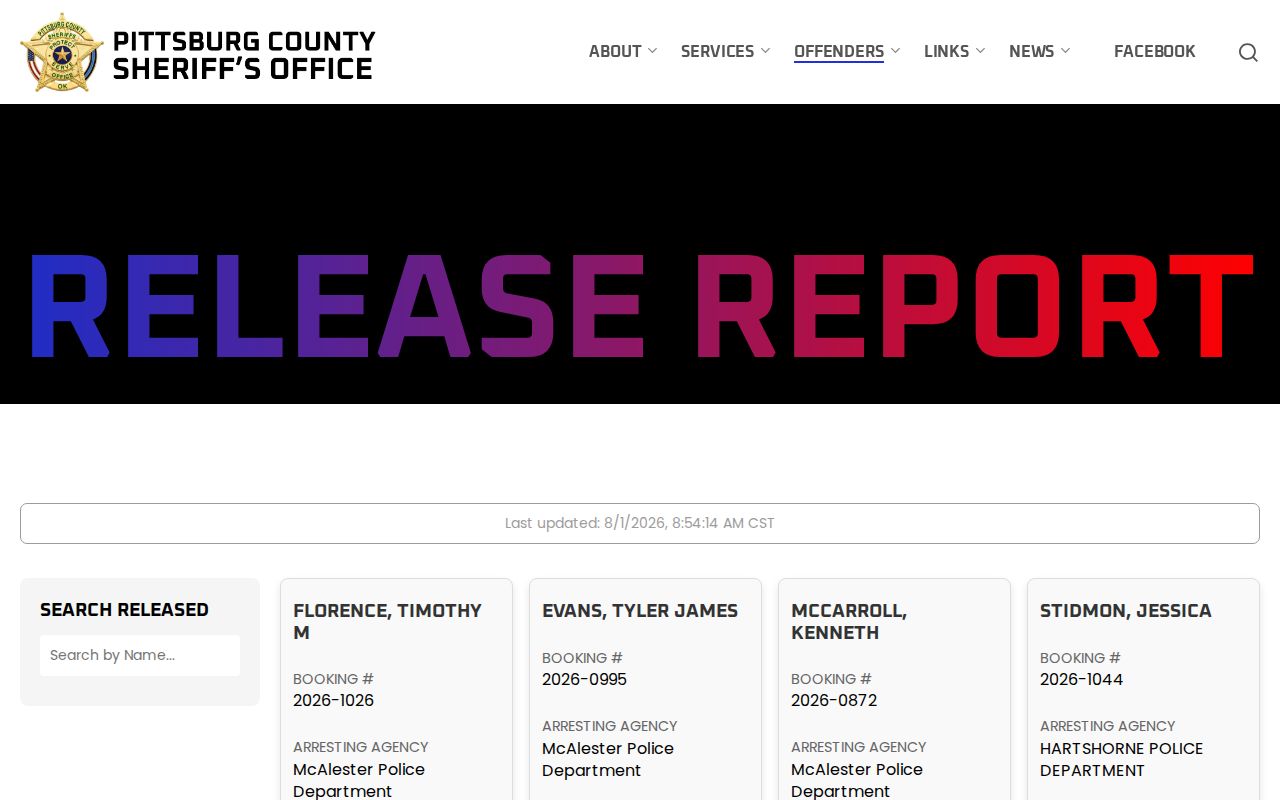
The captured layout shows why exact timestamps, rather than a named 72-hour switch, define the useful window.
Pittsburg Weekend Release Timing
PCSO has not published fixed weekend or holiday release hours. It also has not confirmed a standard delay between physical processing and a public card. The three-day window therefore reduces missed events, but it cannot make the feed instantaneous. A card near the boundary deserves a direct check.
Court timing and jail timing are separate. The PCSO court information page lists weekday Tribal Court at 1 p.m. and District Court initial appearances at 3 p.m., subject to holiday changes. Those are court events, not release hours. Staff must receive and act on an order, clear holds, and complete custody processing before an exit is recorded.
Weekend review should also preserve chronology. A Friday release followed by a Sunday booking is not one continuing status. Compare booking numbers and dates, and keep each event separate. A live roster result dated after the release card can be a later custody episode.
Pittsburg County Release Backup Path
If the rolling report is down, use the PCSO contact page or call 918-423-5858. Ask whether a specific booking was released, transferred, or remains held. If the event is older than the cards online, request the existing booking/release record with the booking number and date range. Research did not confirm a special local request form, a set fee, a promised response time, or a fixed web-retention period.
Use OK VINE as a notification aid for participating Oklahoma jail and ODOC data. It is not a certified release record and may lag. Search ODOC only if the person entered state custody or supervision. A BOP record applies to federal custody, and ICE ODLS applies to immigration custody. The court docket can explain a bond, plea, dismissal, or sentence, but it does not replace the PCSO exit timestamp.
Pittsburg County Rolling Release Limits
Pittsburg County's report was observed to span about seven days, yet the sheriff does not guarantee that duration. A three-day review can normally fit inside the observed span, but an online card may still appear late or roll off earlier than expected. Online display and agency retention are not the same thing.
Save the booking number, exact time, and reason when the record matters. A focused PCSO request is the proper path to an older card. Third-party historical lists cannot replace the custodian's record. Court sources add legal context, while the county record documents when PCSO ended its hold.
Pittsburg Three-Day Release Outcomes
The observed report used BAIL BOND, OWN RECOGNIZANCE, TIME SERVED, PLED, HOLD RELEASED, CASE DISSMISSED, and RELEASED TO ANOTHER AGENCY. Bond and recognizance usually end county detention while proceedings continue. Time served and plea labels still need a court judgment for full legal meaning.
A released hold may leave other matters in place. Dismissal of one case does not speak for unrelated cases. Most important, another-agency language confirms departure from the Pittsburg County Jail but points to a receiving custodian. Follow ODOC, another county jail, BOP, federal court, or ICE based on the destination.
Note: A 72-hour card proves the end of one county booking only; it does not erase later custody, supervision, or another agency's hold.
Confirm Pittsburg County Release Status
Start with the card, then test it against the question being asked. A county release timestamp proves that PCSO's hold ended. A roster search answers whether a person is now shown in the same jail. Court filings explain the order or case outcome. These are complementary records, not substitutes.
| Result | Next confirmation |
|---|---|
| Bond or recognizance | Check the court docket for the order and next case event. |
| Time served or plea | Read the judgment and sentence for completion or supervision terms. |
| Another agency | Identify the receiver and use that custodian's official system. |
| No card found | Check cutoff, roster, and PCSO records before drawing a conclusion. |
This layered method is especially valuable across three days. More elapsed time creates more chances for a later booking, transfer, court filing, or state-system update.
Pittsburg Release Names Across Bookings
A three-day view creates more chances for repeated names. Do not merge cards merely because the spelling matches. The booking number anchors the custody event, and the arresting agency and timestamps help place it in order. A person can leave on one booking and return on another during the same 72-hour span.
When a current roster card and release card both appear, compare their booking numbers first. If the roster booking is later, the earlier release still happened, but it no longer describes present custody. If identifiers conflict, save both entries and ask PCSO to reconcile them. The court case number, when found through the roster or court search, can add context without replacing the sheriff's exact release time.
That same care applies to common names. Use the booking number and date range in any records request. Avoid adding a charge or case from a different booking to the release card, since those fields are not printed on the county's release report.