
Oklahoma State Penitentiary Release Paths
The Oklahoma Department of Corrections operates OSP as an adult male maximum-security state prison. A person may leave the facility through release to the community, parole, discharge at sentence completion, transfer to another ODOC institution, or a handoff to another lawful custodian. Only some of those events end incarceration. The agency and event type must be identified before the word “released” is used as proof that a person returned to the community.
The correct route starts with the ODOC Offender Lookup. Search by ODOC number when possible, or use identity details and then reconcile the result with the conviction county and case. ODOC warns that its public information is abbreviated and has had data-source issues. A result can help match the person and reveal a state-system clue, but it is not an exact account of the sentence or time still to serve.
| State record | What it may establish | Limit |
|---|---|---|
| ODOC lookup | Identity and current state-system clues | Abbreviated, and live fields can vary |
| PPB docket or result | Parole consideration and board action | Not proof of gate release |
| OK VINE | Reported custody change and alerts | May lag the source agency |
| ODOC release document | The specific physical release, discharge, or status event | Disclosure may require authority or review |
Confirm an OSP Release
Build a short chain of state records. Begin with the ODOC number because names can repeat. Then review a parole record only if parole is part of the person’s case. The Oklahoma Pardon and Parole Board publishes monthly dockets and results. A docket means a matter was set for consideration. A result records board action. Neither states that prison staff completed the physical release.
- Search ODOC by number or name and date of birth. Confirm the person against the conviction county and case details available from official sources.
- Note the institution and status clue. A move away from OSP can be a transfer while the person remains in ODOC custody.
- When parole applies, search PPB dockets and results by ODOC number or name. Keep any displayed projected release date separate from the board outcome.
- Check OK VINE for a reported custody change. Treat a notice as a prompt to verify with ODOC, not as a certificate.
- For firm proof, ask ODOC for the named release, discharge, or termination document that answers the question.
A complete county-versus-state search sequence is provided through the Pittsburg County released inmates lookup. That distinction prevents a local jail card from being assigned to a state prisoner with a similar name.
OSP Release and Discharge Records
ODOC policy names several records that can narrow a request. A Certificate of Release or Release Checkout Sheet may document physical release. A Discharge Notice or Termination Summary may address completion. A Parole Status Report concerns supervision. A Notice of Inmate Status Change may explain a move that was not a release. A Final Disposition Report may also fit a specific question. The existence of these record types does not make every document unrestricted.
Start with ODOC Legal Services and identify the person by full name and ODOC number. Name the document rather than asking for an undefined file. Closed Records lists 405-425-2691. ODOC also links an Authorization to Release Incarceration/Supervision Records. Authorization is a route for review, not a promise that every confidential detail will be disclosed.
Oklahoma State Penitentiary
1301 North West Street
McAlester, OK 74502
Phone: 918-558-8084
Operator: Oklahoma Department of Corrections
For central agency questions, ODOC lists 4345 N. Lincoln Boulevard, Oklahoma City, OK 73111-4298 and 405-425-2500. Ask which office maintains the exact release or discharge record. A court judgment may explain the sentence, while ODOC records show how the state administered custody. Both can be needed when dates or labels appear to conflict.
OSP Projected Release Dates
A projected release date is an estimate. ODOC policy refers to a projected date, and public PPB dockets can display one. ODOC’s offender-information guidance also says a particular inmate’s release date is confidential without a legitimate need and calls the date tentative. Because the public result screen can change and may be blocked by session controls, no result should be promised to show an exact date, photograph, released label, or supervising office every time.
Credits, achievement credits, misconduct, restored or lost credits, new judgments, jail-time adjustments, consecutive sentences, detainers, parole action, and correction of a calculation can change a projection. A past estimate is not the same as a Certificate of Release. It also cannot show whether another authority assumed custody at the prison gate.
- Projected release date
- ODOC’s current estimate based on the sentence information and credit rules then in effect.
- Parole
- Conditional release from prison for the balance of the confinement term, subject to supervision.
- Discharge
- Completion of the sentence or supervision addressed by the record.
- Transfer
- Movement to another custodian or institution while custody continues.
Keep those labels distinct. A favorable PPB action may still be followed by residence approval, a program requirement, detainer resolution, paperwork, or another agency’s hold. Confirm the actual state event after the projected date passes.
OSP Release Alerts Through VINE
OK VINE covers participating ODOC information and can provide reported custody status and notifications. Select Oklahoma, search the person by name or offender identifier, compare the identity and facility details, and open the correct record. Registration may offer phone, email, text, app, or other supported channels. Complete the verification method shown by the live service and keep the contact information current.
The service is useful for notice, not formal proof. Agency data can lag. PPB also warns that OK VINE does not provide parole-hearing notifications. Qualifying registered victims use the separate PPB Victim Notification Program for that function. A VINE status change should lead back to ODOC and the release record.
Note: OK VINE covers state custody changes, while PPB dockets cover parole proceedings and ODOC records confirm the release or discharge event.
OSP Release Holds and Detainers
A person can finish one part of ODOC custody yet move directly to another custodian. A detainer is a request or notice tied to another authority’s claim to custody. The receiving authority might be another state, a federal agency, a county, or immigration officials. An OSP release record should therefore be read for its destination, not just its date.
ICE explains that an immigration detainer requests notice and permits custody for up to 48 extra hours beyond the time a person would otherwise be released so DHS may assume custody. If immigration custody follows, the ICE locator may show current detainees and people released from ICE custody within a recent 60-day window. The OSP event and the later ICE event remain separate.
No ICE detention facility in Pittsburg County was confirmed. A detainer does not establish where a person was taken or whether ICE later released the person. Ask ODOC for the receiving agency when that detail is legally available, then verify through the new custodian.
OSP Release Records Since 1908
ODOC traces Oklahoma’s first state prison to McAlester. OSP opened in September 1908, and the first 100 inmates arrived from Lansing, Kansas on October 14 of that year. The agency identifies it today as Oklahoma’s fully maximum-security institution. That history sets OSP apart from the county jail and from McAlester’s minimum-security state prison.
The ODOC facility information places modern institution decisions within the statewide system. The captured source view supports the agency-first route for OSP and nearby JBCC.
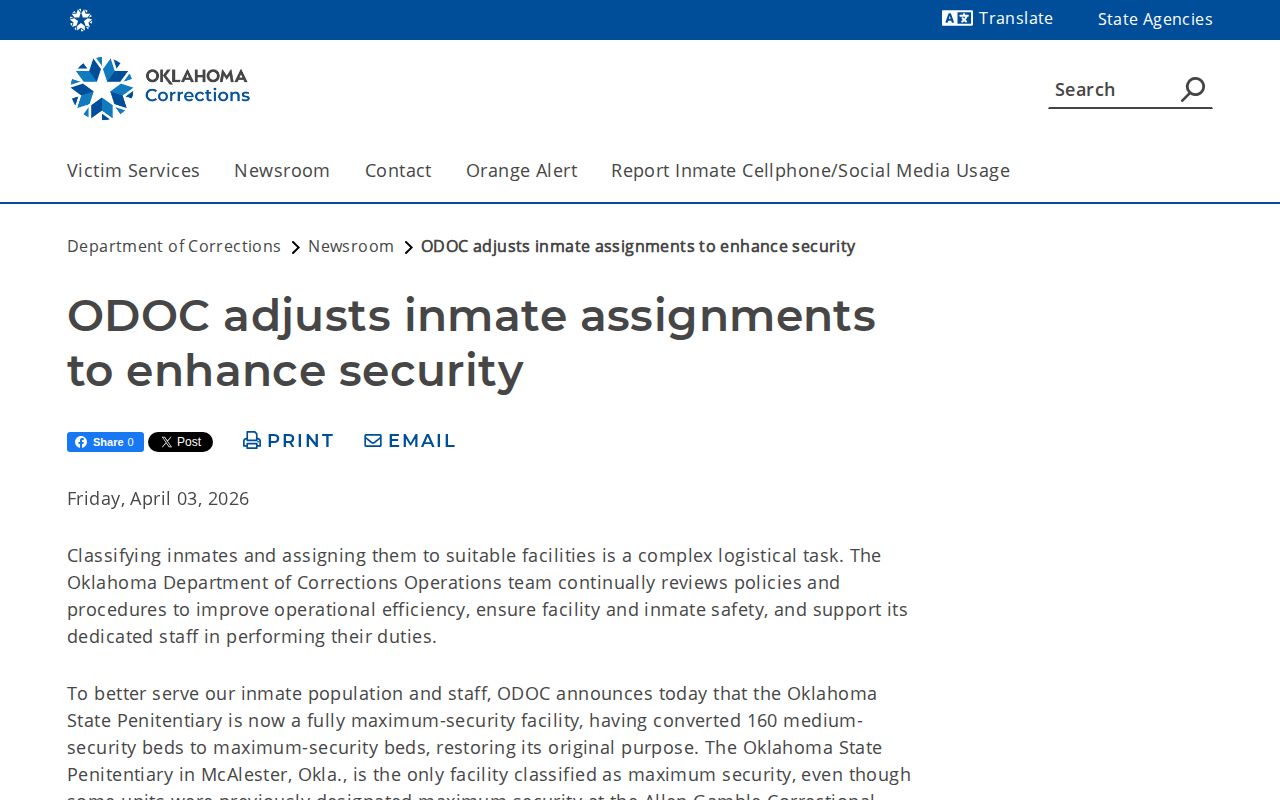
The image shows why an ODOC source, rather than the county release report, governs prison status. Historical location does not merge the agencies. A person may transfer from OSP to another state prison and remain incarcerated.
McAlester Prison Release Boundaries
McAlester contains Pittsburg County Jail, OSP, and Jackie Brannon Correctional Center. OSP is maximum security. JBCC is minimum security. The jail holds county detainees and uses PCSO records. A city-only search can therefore blend three institutions and two record systems.
Search the custodian shown on the most recent verified record. For OSP, that is ODOC, supported by PPB and OK VINE when those systems apply. For the county jail, it is PCSO. This simple boundary also clarifies where a release record request belongs and why a sheriff’s recent-release card cannot prove an OSP discharge.
A transfer between OSP and JBCC is still state custody. Even when a person leaves the OSP grounds, the ODOC record must show whether the move was release, parole, discharge, or transfer. The destination field or formal document supplies the needed distinction.